
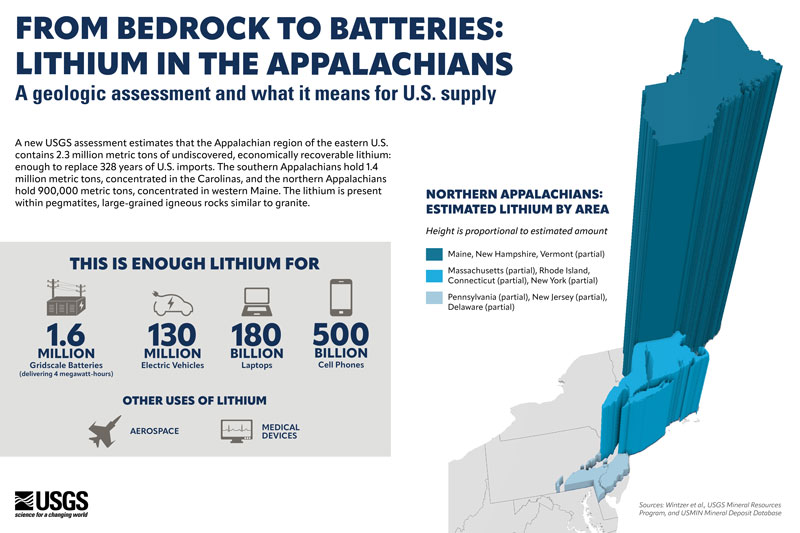
The Appalachian region of the eastern United States contains an estimated 2.3 million metric tons (Mt) of undiscovered, economically recoverable lithium, enough to replace 328 years of U.S. imports at last year’s level, according to new research by the U.S. Geological Survey.
The southern Appalachians hold an estimated 1.43 Mt of lithium oxide, concentrated in the Carolinas, and the northern Appalachians hold an estimated 900,000 metric tons, concentrated in Maine and New Hampshire, according to estimates in a new USGS scientific paper published in Natural Resources Research. The lithium is present in pegmatites, large-grained rocks similar to granite.
“This research shows that the Appalachians contain enough lithium to help meet the nation’s growing needs – a major contribution to U.S. mineral security, at a time when global lithium demand is rising rapidly,” said USGS Director Ned Mamula.
“USGS mineral science is the leading edge in the effort to restore America’s mineral independence by mapping our nation’s mineral resources. Everything else follows on the science: permitting reform and other policy changes to support investment in clean, responsible mining to 21st-century standards, and mining workforce training for new American jobs. The United States was the dominant world producer of lithium three decades ago, and this research highlights the abundant potential to reclaim our mineral independence.”
While Australia is the world’s largest producer of lithium, China is second and accounts for the majority of global lithium refining and consumption. The U.S. had one sole producer of lithium last year – Albemarle’s Silver Peak mine in Nevada.
The USGS projects that world production capacity for lithium will double by 2029, driven by increasing demand. The northern Appalachians lithium assessment can be found here. Details from the southern assessment covering the Appalachians from Maryland to Alabama will be published later.
Source: USGS